A trader can be correct about the direction of EUR/USD and still enter the market badly. The reason is simple: deciding what to trade is only part of the process. The order chosen to enter or exit can influence price, timing and whether the trade executes at all. Understanding forex broker order types gives traders more control over that process.
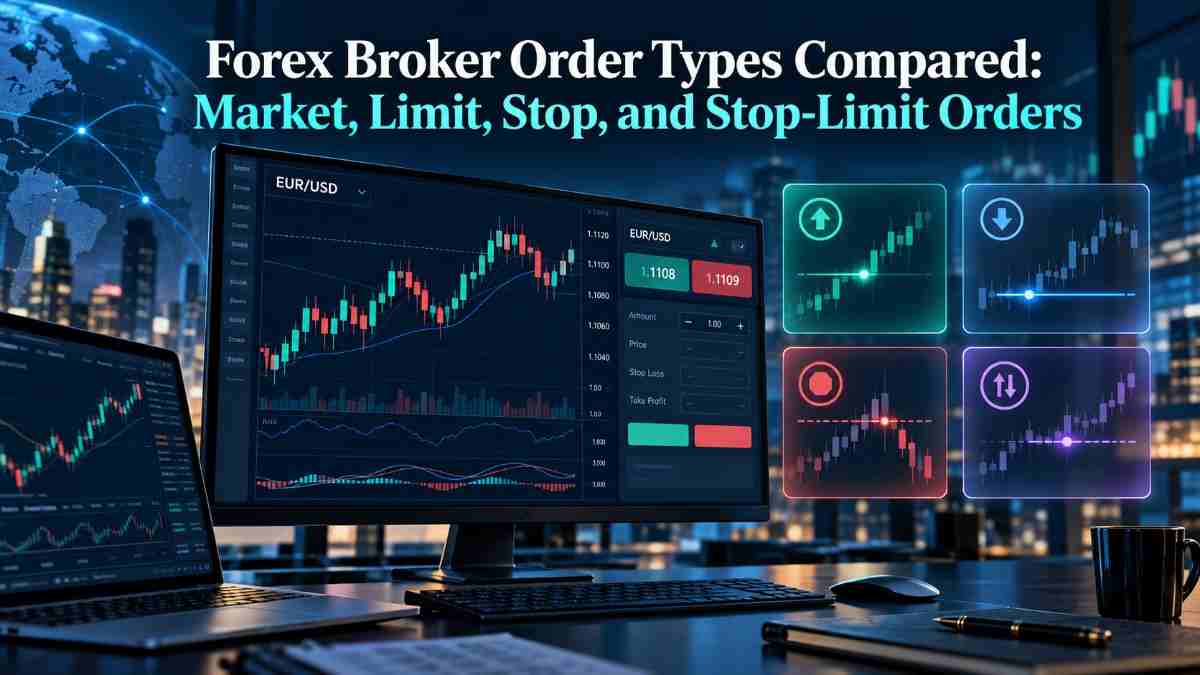
A market order prioritises immediate execution. A limit order waits for a specified price or better. A stop order activates after the market reaches a trigger, while a stop-limit order adds a maximum or minimum acceptable execution boundary after that trigger. These forex broker order types solve different problems. None is universally better than the others.
What Are Forex Broker Order Types?
Forex broker order types are instructions telling the broker how and under what conditions a trade should be executed. MetaTrader 5 divides instructions broadly into market and pending orders. Its official trading documentation supports market orders together with Buy Limit, Sell Limit, Buy Stop, Sell Stop, Buy Stop Limit and Sell Stop Limit orders.
The platform also supports Stop Loss and Take Profit instructions. A market order is intended for execution now. Pending orders trading allows a trader to define conditions that must occur before a future trade is submitted. The distinction matters because price certainty and execution certainty rarely come together perfectly.
Forex Market Order: Trading at the Available Price
A forex market order tells the broker to buy or sell at the available market price. Suppose EUR/USD is displaying a bid of 1.1798 and an ask of 1.1800. A trader who wants to buy immediately can submit a market order.

The actual execution may occur around the available ask, but the final fill is not always guaranteed to equal the exact quote visible when the trader clicked. Markets can move during order transmission.
MetaTrader explains that the exact execution behaviour depends on the execution mode configured by the broker for the instrument. This makes forex order execution particularly important during volatile periods. A market order prioritises participation rather than insisting on one exact price.
Advantages and Limitations of a Forex Market Order
The biggest advantage of a forex market order is simplicity. If a trader receives a valid strategy signal and wants exposure immediately, there is no need to wait for a future price trigger.
The disadvantage is price uncertainty. A currency pair can move between the moment an order is submitted and the moment it is executed. This difference is commonly called slippage.
Slippage can be especially noticeable around central-bank decisions, inflation announcements and unexpected geopolitical news. For that reason, traders should not interpret “market order” as “guaranteed displayed price.”
Forex Limit Order: Entering at a Chosen Price or Better
A forex limit order is used when price matters more than immediate participation. A Buy Limit is normally placed below the current market. Suppose EUR/USD trades at 1.1800, but a trader wants to buy only if the pair falls to 1.1750. A Buy Limit can be placed around that level. A Sell Limit works in the opposite direction and is normally placed above the current market.
MetaTrader describes a Buy Limit as an instruction to buy at the specified Ask price or lower, while a Sell Limit seeks execution at the specified Bid price or higher. A forex limit order therefore lets the trader wait rather than chase the market.
The Main Risk With Limit Orders: No Fill
Price control comes with a trade-off. A forex limit order may never execute. Suppose EUR/USD trades at 1.1800 and the trader places a Buy Limit at 1.1750. The market could rally directly to 1.1900 without ever reaching 1.1750. The trader avoids paying a worse entry price but also misses the trade.

That is why limit orders are frequently associated with pullback and mean-reversion approaches rather than strategies that require immediate breakout participation. The broader platform also matters. TopBrokerRating’s FirstECN review describes how platform tools and real-time pricing form part of the trading environment in which such decisions are made.
Forex Stop Order: Waiting for Confirmation
A forex stop order is typically used to enter after price moves through a specified trigger. A Buy Stop is normally placed above the current market. Suppose GBP/USD trades at 1.3400 and resistance sits near 1.3450. A trader who wants confirmation that price can break above resistance could place a Buy Stop at or above that area.
A Sell Stop is generally placed below the current market. This makes a forex stop order useful for breakout-based strategies. Once the stop trigger is reached, the resulting order normally seeks execution at the available market price. That creates the possibility of slippage.
Stop Entry vs Stop-Loss
The word “stop” can create confusion because a forex stop order can be used in more than one context. A stop entry opens a position after a trigger is reached. A stop-loss is intended to close an existing position when price moves against the trader.
The underlying trigger idea is similar, but the purpose is different. A Buy Stop above the market might open a new long trade. A stop-loss below an existing long position would close that trade if the market falls. Understanding this distinction is fundamental when using more advanced forex broker order types.
Stop Limit Order Forex: Combining a Trigger With Price Control
A stop limit order forex instruction combines a stop price with a separate limit price. MetaTrader 5 supports both Buy Stop Limit and Sell Stop Limit instructions. The process happens in two stages.

First, the market reaches the stop trigger. Second, instead of immediately creating a market order, the system places a limit order at the specified limit level. Suppose EUR/USD trades at 1.1750. A trader wants to act on a breakout above 1.1800 but refuses to buy above 1.1810.
A stop trigger can be set around 1.1800 with the related limit condition defining the acceptable execution level. This provides greater price control than a simple stop order.
Why Stop-Limit Orders Can Miss Fast Markets
A stop limit order forex does not guarantee execution. Imagine that price jumps rapidly from 1.1795 to 1.1820 after major economic news. The stop condition may activate, but the market may already be beyond the acceptable limit price. The resulting limit order can therefore remain unfilled.
This is the main trade-off:
- A stop order provides greater execution certainty after triggering but potentially more slippage.
- A stop-limit order provides greater price control but lower certainty that the position will actually open.
MetaTrader’s order execution guide specifically describes stop-limit orders as combining stop and limit behaviour to control slippage.
Comparing the Main Forex Broker Order Types
The practical differences between the main forex broker order types can be summarised like this:
| Order Type | Main Priority | Typical Use | Key Risk |
| Market | Immediate execution | Enter now | Slippage |
| Limit | Entry price | Buy lower or sell higher | Order may never fill |
| Stop | Trigger confirmation | Breakout entry | Slippage after trigger |
| Stop-Limit | Trigger + price control | Controlled breakout entry | Triggered but unfilled |
No order can remove market risk.
The correct choice depends on what the strategy needs most.
What Are Pending Orders Trading?
Pending orders trading means giving the broker an instruction that remains inactive until specified future conditions are satisfied. Limit, stop and stop-limit instructions can all fall within this broad category.
MetaTrader allows pending orders to have different expiration rules. Depending on the broker and instrument, an order might remain active until cancelled, expire at the end of the trading day or expire at a specifically chosen date and time. This is useful because a trading idea does not remain valid forever.
An order placed around today’s technical setup may no longer make sense several sessions later. Traders should therefore check the expiry setting before leaving pending orders trading unattended.
Forex Order Execution Matters After the Trigger
Selecting the right order does not remove the importance of forex order execution. A stop can trigger at the requested level but execute at a different available price. A market order can experience slippage.
A limit order can remain unfilled because insufficient liquidity was available at the requested price. MetaTrader also supports different fill policies, depending on the instrument and broker configuration.
The actual platform setup therefore matters just as much as the theoretical definition of the order. TopBrokerRating’s Airmarkets review provides another example of why platform access, trading conditions and execution controls should be considered together when evaluating a broker.
Bid and Ask Prices Affect Order Triggers
A chart can make an order look as though it should have triggered even when the relevant executable price never reached the level. Forex is quoted with two prices: bid and ask.
A buy transaction generally executes using the ask. A sell transaction generally executes using the bid. MetaTrader’s documentation reflects this distinction when describing its order types.
If a chart displays only the bid or a midpoint price, the other side of the spread may not be immediately visible. This is particularly relevant for stop-loss disputes and pending orders trading during periods when spreads widen.
Which Forex Broker Order Type Should You Use?
There is no correct answer for every strategy. A trader who must enter immediately after a confirmed signal may choose a forex market order. A trader waiting for a pullback could use a forex limit order.
A breakout trader may prefer a forex stop order, while someone who wants breakout confirmation but refuses to accept excessive slippage might consider a stop limit order forex instruction where the broker supports it.
The trade setup should determine the order. Choosing an order first and then forcing the strategy around it reverses the logic.
Test Order Behaviour Before Trading Large Positions
Demo trading is useful for learning how different forex broker order types behave on a platform. Place small market, limit and stop orders. Watch which bid or ask price triggers them and examine how expiry settings work.
Demo fills may not perfectly reproduce live liquidity, but the exercise helps avoid operational mistakes. TopBrokerRating’s HeroFX review also highlights the importance of platform and execution testing when assessing a broker. Knowing which button to press before real money is at risk is considerably better than learning the mechanics during a volatile market.
Final Thoughts
The main forex broker order types are not competing versions of the same tool. Each represents a different balance between price, timing and certainty of execution.
A market order prioritises trading now. A limit order prioritises an acceptable price.
A stop order waits for a trigger before seeking market execution, while a stop-limit combines that trigger with a price boundary. Understanding forex order execution is what connects those definitions to real trading.
Spreads, slippage, liquidity and broker settings can all influence what happens after the button is pressed. The best order is therefore the one that matches the strategy’s actual requirement-not simply the one that sounds most advanced.
Disclosure
This article is for educational and informational purposes only. It is not financial, investment, legal, tax or trading advice. Forex and CFD trading involves substantial risk, and order execution can vary according to liquidity, volatility and broker conditions. Always understand an order type before using it with live capital.
FAQs
What are the main forex broker order types?
The main forex broker order types include market orders, limit orders, stop orders and stop-limit orders. Platforms may also provide Stop Loss, Take Profit and additional order-management functions.
What is a forex market order?
A forex market order instructs the broker to buy or sell at the available market price rather than waiting for a specified future level.
What is a forex limit order?
A forex limit order seeks execution at a specified price or better. Buy limits are normally below the current market and sell limits above it.
What is a forex stop order?
A forex stop order activates after the market reaches a specified trigger. It is commonly used for breakout entries or as part of stop-loss risk management.
What is a stop limit order forex?
A stop limit order forex combines a stop trigger with a limit instruction. It controls the acceptable execution price but may remain unfilled after triggering.
What are pending orders trading?
Pending orders trading involves submitting instructions that execute only after specified market conditions are reached rather than immediately.
Can forex order execution differ from the price on my screen?
Yes. Forex order execution can be affected by market movement, spread, liquidity and the order type being used. Market and stop orders can experience slippage.