When you turn on your trading platform in the morning, EUR/USD currency pair appears with a very narrow spread. However, after lunch it becomes wider. Then later, it widens up again before the news release. Many traders find it hard to understand what happens to the forex spreads and whether brokers are trying to cheat on them. Actually, the truth is much more simple – the spread changes because of the market fluctuations that happen continuously.
This article will help you to understand why the spreads change, when they become narrow or wide, and how to deal with different spreads of forex pairs.
What Is a Forex Spread?
The spread is the difference between the price at which the instrument can be sold (the bid price) and the price at which it can be bought (the ask price). The spread is often the primary cost for a trade.
A market spread is formed by banks, funds, and various liquidity providers that set their prices. Your broker forwards the prices to you, possibly adding a markup to them. In other words, the spreads that you see at your trading platform depend on both the market and the pricing model used by your broker.
Why Forex Spread Changes Happen
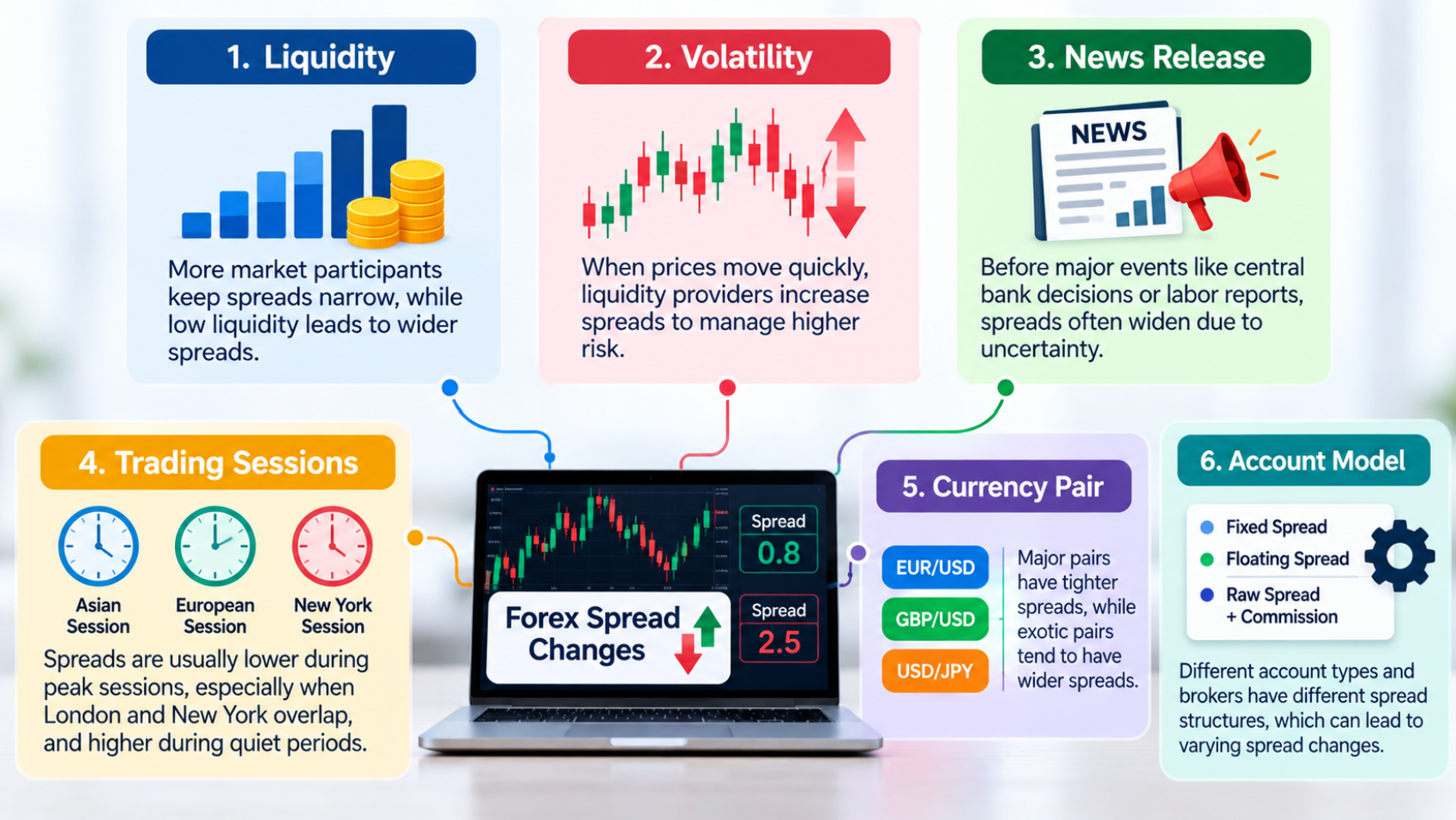
Liquidity
Liquidity is the number of participants in the market. Where there are many participants, the price range will be very narrow while where there are few participants, the range will be wide. Low liquidity is the most common reason for widening forex spreads.
Volatility
Where prices are changing rapidly, liquidity providers will incur increased risks. As a result, most of them increase the range in order to hedge against the risks involved. When prices change, the spread will change along with them. This type of widening of forex spreads is possible even where your broker has not changed anything.
News Release
Before a significant event like the decision by the central bank or any labor market report, the liquidity providers will widen the range in order to protect themselves against sudden changes. Most of the traders will wait for the release of the data before acting.
Trading Sessions
Forex markets operate 24 hours a day, five days a week, with activity varying across the Asian, European, and American trading sessions. Spreads usually become narrower during periods of higher trading activity, particularly when the London and New York sessions overlap. They can widen during quieter periods, such as the daily rollover around the transition between the New York close and the start of the Asian trading day. For additional information about forex brokers and trading conditions, readers can also explore TopBrokerRating.
This makes the changes of forex spreads rather predictable. Forex spread changes have their routine which can be studied.
Currency Pair
Major currency pairs such as EUR/USD trade in high volumes and therefore provide tighter spreads compared to exotic pairs. The less participants in the market of this currency pair – the greater will be the difference between sellers and buyers.
Account Model
There are some accounts with floating spreads which follow the live market and other accounts with fixed spreads. There are accounts with a raw spread and a commission. You may experience different spread fluctuations depending on the account model you use. The spreads also differ from broker to broker because of different liquidity providers.
Variable Spreads vs Fixed Spreads
- Variable spreads: These follow live market conditions. They are often tight in calm, busy hours and wider under stress. ECN-style accounts commonly work this way.
- Fixed spreads: These stay at a set level in normal conditions. They are easier to plan around, but they may cost more on average, and a broker may still change them in extreme markets. Always read the terms.
Variable spreads are not a trick. A live market cannot keep a price gap frozen at all times. If a broker offers fixed pricing, the broker takes on that risk, and the cost of that comfort may be built into the spread. Neither type is “better” for everyone. It depends on how and when you trade.
When Are Spreads Usually Tightest and Widest?
Tighter spreads are common during:
- The London and New York overlap
- Major sessions with high volume
- Major pairs in busy hours
Wider spreads are common during:
- The daily rollover
- The minutes around major news
- The market open after the weekend, when liquidity is still building
- Holidays and other thin trading days
- Exotic pairs, at nearly any time
Forex spread widening is normal in these windows. In quiet hours, the market spread is thinner, so even a small order can move the price.
How Spread Changes Affect Your Trades
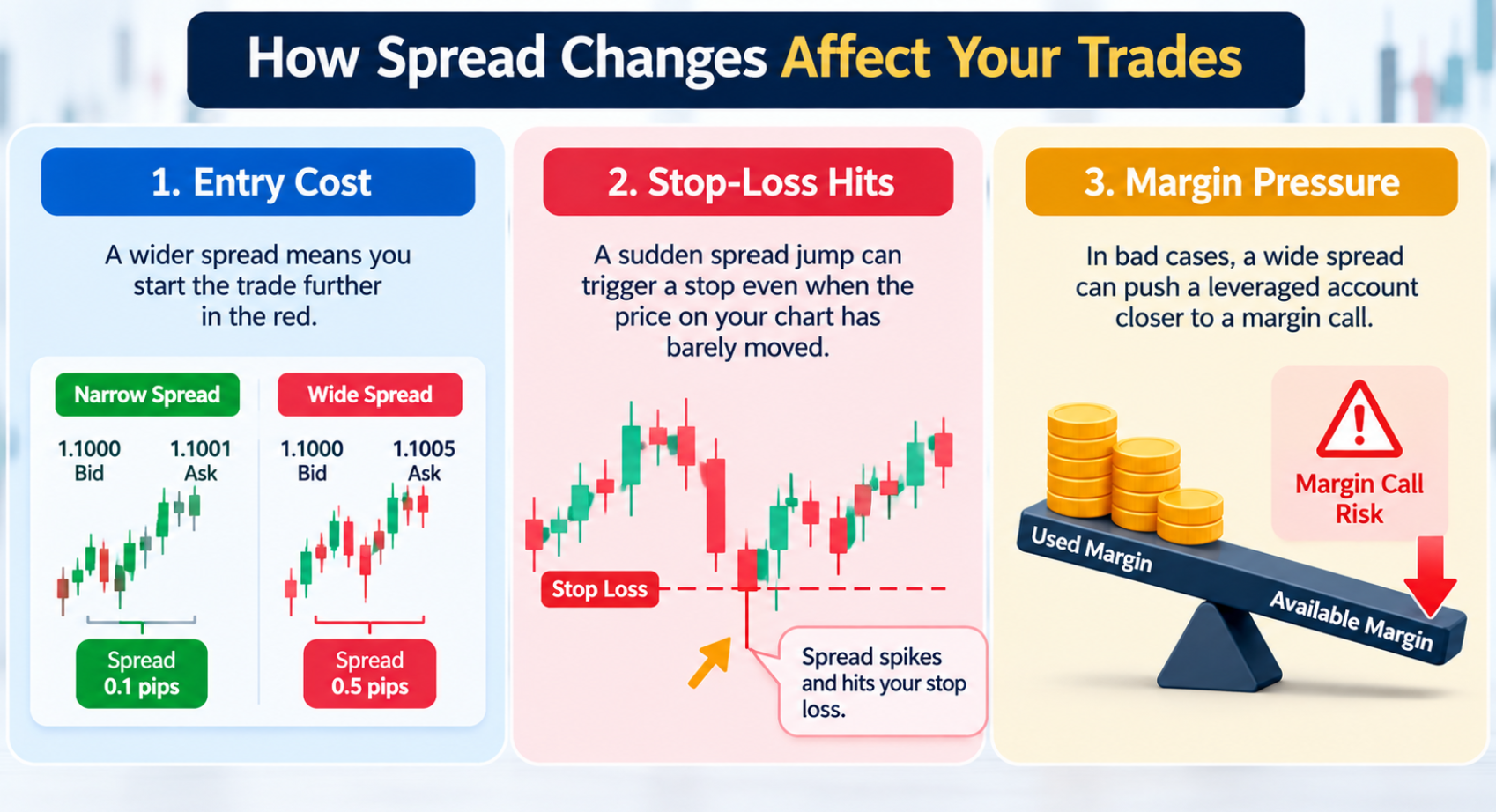
A spread is a cost, so spread changes can hit your results in three ways:
- Entry cost: A wider spread means you start the trade further in the red.
- Stop-loss hits: A sudden jump can trigger a stop even when the price on your chart has barely moved.
- Margin pressure: In bad cases, a wide spread can push a leveraged account closer to a margin call.
Imagine a trader scalping for a three-pip profit on a currency pair that normally has a one-pip spread. During a major news event, the spread widens to five pips, significantly increasing the cost of entering the trade before the market even moves. This example highlights why traders should consider spread changes and execution conditions during volatile periods. For more information about forex trading and broker conditions, readers can also explore BabyPips.
Forex spread changes hit short-term traders hardest. Long-term traders aim for bigger moves, so they usually feel changing forex spreads less.
When Forex Spread Changes Are Normal, and When to Worry
Normal signs:
- Spreads widen around news or rollover
- Other brokers show a similar jump at the same time
- Spreads return to normal soon after
Worth checking:
- Wide spreads on a major pair in the middle of a busy session, with no news
- Broker spreads far above the level shown on the account page, again and again
- A big gap between your broker and others at the same moment
Repeated forex spread widening in calm, liquid markets is a fair thing to question. If you see it, take screenshots with the time, compare with another platform, and ask support for an explanation. Check the broker’s terms for notes on spreads in fast markets. If the answers do not add up, you can contact the broker’s regulator. Clear records make any complaint stronger.
How to Manage Changing Forex Spreads
Most forex spread changes can be planned for. These habits help:
- Trade in busy hours, when the market spread is usually tighter
- Check an economic calendar and avoid new trades right before big releases
- Skip the rollover window for short-term trades
- Use limit orders where you can, so you control your price
- Leave room for the spread when you place stops
- Stick to major pairs if low cost matters most
- Watch the live quotes, since variable spreads can change in seconds
How to Compare Broker Spreads Before You Join
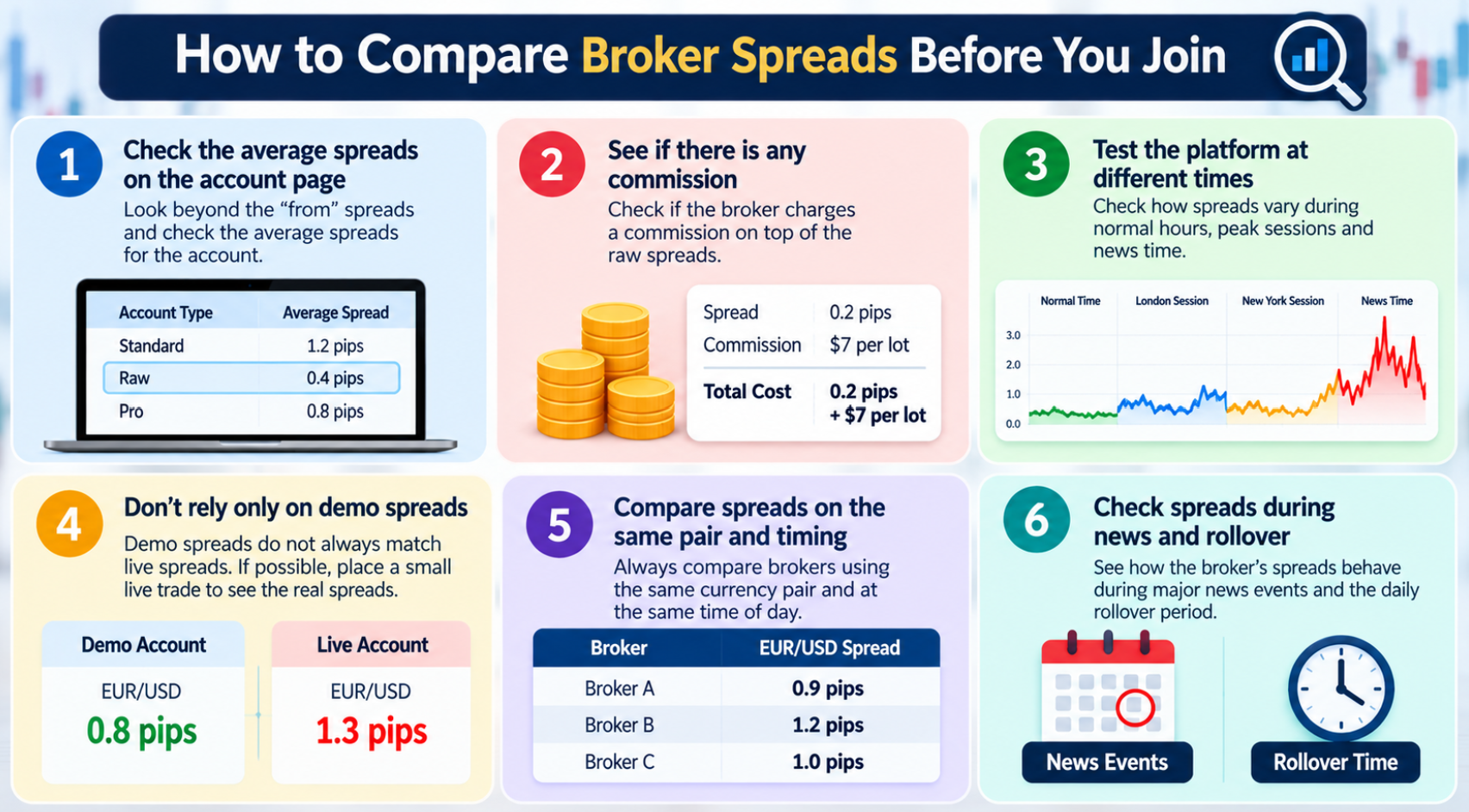
The advertised “from” spreads are indicative of the lowest spreads, and not the price at which you would be trading for the whole day. So look further:
- Look into the account page to get the average spreads of that account.
- See if there is any commission on top of the raw spreads.
- Test the platform at various timings, including during news time. See how the spreads vary.
- The demo spread does not always replicate the live spread, and hence do check with a small live trade if possible.
- Compare the broker spreads on the same pair and at the same timing.
- Look into the spreads of the broker during news and rollover.
Final Thoughts
It is a natural occurrence for changes in forex spreads in forex trade. They depend on liquidity, volatility, news, and timing, and then there is the effect of the pricing structure of the broker. It is natural for forex spreads to widen during news time or rollover time.
This should not be a cause for concern; what should be is the consistent widening of forex spreads in low-volatility times or in high-volatility times.
FAQs
- What causes forex spread changes?
Liquidity, volatility, news, trading sessions, the currency pair, and your broker’s pricing model. When fewer traders are active, the market spread usually grows. - Why do variable spreads widen at rollover?
Rollover happens between the New York close and the Tokyo open, when liquidity is thin. With fewer prices on offer, the gap between bid and ask grows. - Is forex spread widening a sign my broker is cheating?
Not usually. Widening around news, rollover, or holidays is normal. Repeated widening on a major pair in a calm, busy session is worth questioning. - How do I compare broker spreads fairly?
Check the same pair at the same time on each platform. Look at average spreads, not just “from” figures, and add any commission to the cost. - Can I avoid changing forex spreads completely?
No, but you can reduce their effect. Trade in busy sessions, avoid news and rollover, and use limit orders to control your entry price.