The UAE has become one of the most active financial centres for global traders, especially because Dubai and Abu Dhabi attract international banks, fintech firms, brokers, investors and high-net-worth clients. That has made forex trading in UAE a common search topic for beginners who want access to currency markets but do not want to step into an unclear or unsafe trading setup.
The opportunity is real, but so is the risk. Forex is a leveraged market. A small price move can create a larger account gain or loss, and a weak broker can make the experience worse through poor execution, unclear fees or difficult withdrawals. That is why this forex trading UAE guide focuses first on rules and broker verification, not only trading strategies.
Anyone researching forex trading in UAE should understand three points from the beginning: forex access exists, regulation depends on the broker’s legal entity, and traders must verify the exact product they are being offered before depositing funds.
Forex Trading in UAE: Is It Legal?
A common beginner question is is forex trading legal in UAE. The practical answer is that forex-related services can be offered in the UAE when the firm is properly licensed or authorised for the relevant activity and jurisdiction. The key is not only whether forex exists in the country, but whether the specific broker, entity and product are properly authorised.
The Dubai Financial Services Authority says only firms authorised and licensed by the DFSA can provide financial services in or from the Dubai International Financial Centre, and it advises users to search the DFSA Public Register before dealing with a firm. The DFSA also explains that authorisation is required for firms conducting financial services in or from the DIFC.
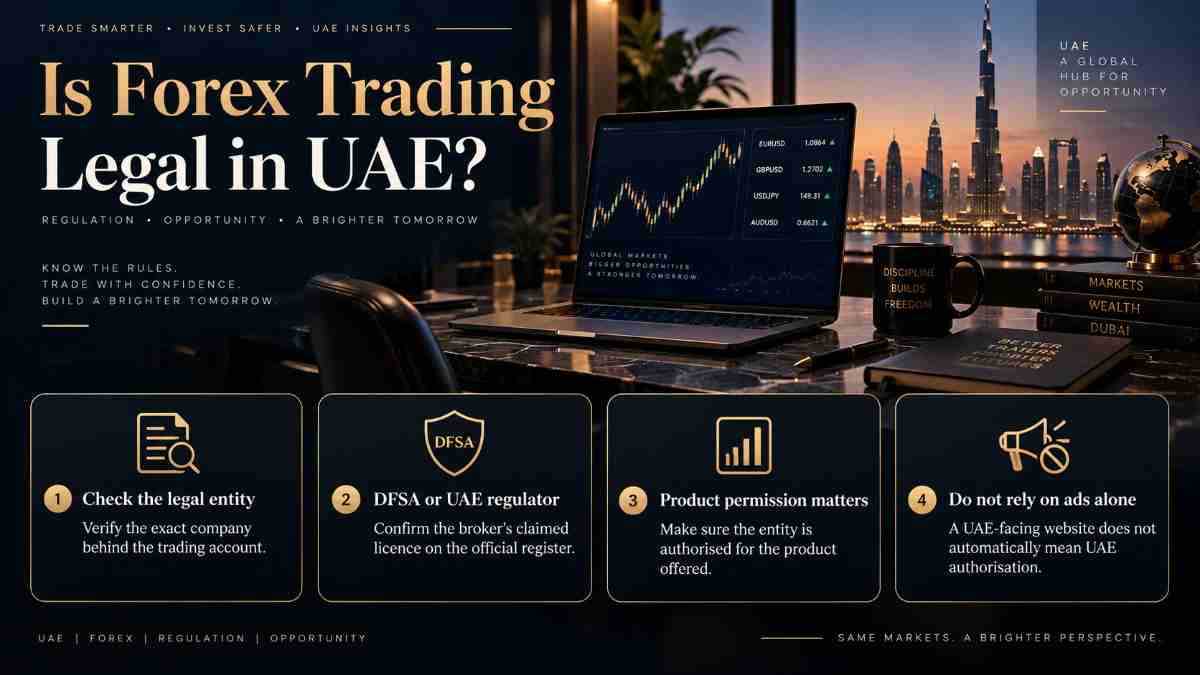
Outside the DIFC, the UAE Securities and Commodities Authority lists licensed companies and financial activities, including trading broker activity connected with OTC derivatives and currencies in the spot market. The Central Bank of the UAE also says it is responsible for licensing, governing and supervising financial institutions in the UAE.
So, is forex trading legal in UAE? In broad terms, yes, but traders should avoid treating that as a shortcut. The real question is whether the broker you choose is authorised for the exact account and instrument you are using.
UAE Forex Trading Rules: What Beginners Should Know
UAE forex trading rules are not controlled by one simple headline. The regulatory position can depend on where the broker operates, whether it is inside the DIFC, whether it is under another UAE framework, or whether the trading account is opened through an offshore entity.
This is where many beginners make a mistake. A broker may advertise services to UAE residents while the client agreement names a different company outside the UAE. Another firm may have a Dubai office but route retail trading accounts through an entity in another jurisdiction. That does not always mean the broker is unsafe, but it does mean the trader must read the legal documents carefully.
The DFSA’s Conduct of Business material defines products such as CFDs and rolling spot forex contracts within its rule framework, showing that the regulatory treatment of forex-style products depends on the substance of the arrangement, not simply the label used by a broker.
For a beginner, UAE forex trading rules come down to practical checks. Confirm the legal entity. Confirm the regulator. Confirm the product permission. Confirm whether the broker accepts retail clients. Confirm whether the risk warning, account agreement and website all name the same company.
Forex Trading in UAE: Check the Broker Before the Platform
The first serious step in forex trading in UAE is broker verification. Platform design comes later. A smooth mobile app, tight advertised spread or friendly account manager means very little if the legal entity is unclear.
TopBrokerRating’s guide to top regulated forex brokers with low spreads is useful for comparing broker cost and regulation factors. The site also publishes broker reviews through its broker review section where traders can compare account features, platforms, minimum deposits and stated regulatory details.
When checking forex brokers in UAE, do not rely only on a homepage badge. Go to the regulator’s official register. Match the company name, reference number, domain and permitted activity. If the broker claims to be regulated by the DFSA, check the DFSA Public Register. If the firm claims UAE mainland authorisation, review the relevant UAE authority’s register or licensed-company database.
A reliable broker makes verification easy. A risky broker often makes marketing easy and verification difficult.
How to Trade Forex in UAE: Step-by-Step
The best way to understand how to trade forex in UAE is to treat it as a process rather than a one-click account opening.
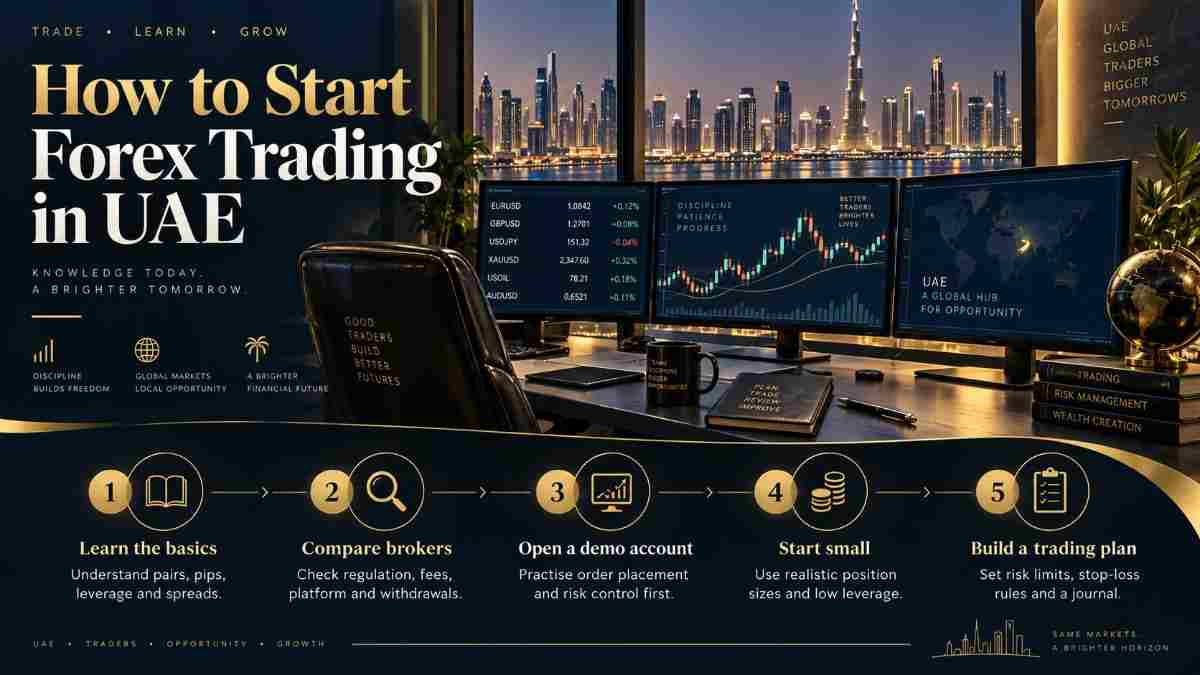
Start with education. Learn what currency pairs are, how pips work, how margin is calculated, why leverage increases risk and how spreads affect every trade. Then choose a small group of major pairs before moving into minor or exotic pairs. Beginners do not need twenty charts open; they need a repeatable process.
Next, compare brokers. A serious comparison of forex brokers in UAE should include regulation, account entity, spreads, commissions, swap charges, withdrawal rules, trading platform, customer support and risk warnings. TopBrokerRating’s FirstECN review and FXRoad review show the kind of broker-level details traders often review, including platform access, account types, leverage, tradable markets and withdrawal information.
After that, open a demo account if available. Demo trading helps beginners learn order placement, stop-loss settings, position size and platform behaviour. Then, if moving live, start small. A beginner learning how to trade forex in UAE should focus first on not losing control, not on chasing fast profit.
Forex Trading for Beginners UAE: Risk Comes Before Returns
For forex trading for beginners UAE, the biggest early challenge is usually not chart reading. It is discipline. Many new traders understand a basic setup but fail because they overtrade, use too much leverage or move stop-losses when the market goes against them.
Leverage deserves special caution. A leveraged forex position allows a trader to control a larger exposure than the account balance would normally allow. That can magnify gains, but it can also magnify losses. In a fast market, the account can move sharply before a beginner has time to react.
A practical plan for forex trading for beginners UAE should include a fixed risk per trade, a maximum daily loss, a simple journal and a clear rule for when to stop trading. No broker, indicator or signal service can replace those rules.
Beginners should also avoid guaranteed-profit claims. The DFSA issues alerts about scams and potentially fraudulent practices that may harm investors and damage the reputation of the DIFC. It also tells users to verify firms through the DFSA Public Register before investing.
Choosing Forex Brokers in UAE
Choosing forex brokers in UAE is partly about regulation and partly about trading conditions. Regulation helps define the framework under which the firm operates. Trading conditions decide what the trader actually experiences day to day.

Look at spreads and commissions first. A low minimum spread in an advertisement may not reflect the average spread during active sessions or major news. Then review swap charges, inactivity fees, deposit methods, withdrawal rules and currency conversion costs.
Execution quality also matters. During inflation reports, central-bank decisions or oil-price shocks, spreads can widen and slippage can appear. That is when broker quality becomes more visible. TopBrokerRating’s Liquid Brokers review on fees and spreads is relevant because it shows why trading fees, platform structure and execution details must be reviewed before funding an account.
When comparing forex brokers in UAE, also read the broker’s risk disclosures. If the broker hides leverage terms, withdrawal steps or complaint procedures, that is a warning sign. A professional broker should not make basic information hard to find.
Islamic Forex Trading Account UAE: What to Check
An Islamic forex trading account UAE is usually marketed as a swap-free account designed for traders who want to avoid overnight interest charges. These accounts can be useful for some traders, but the details matter.
A trader checking an Islamic forex trading account UAE should ask how the broker structures costs. Some swap-free accounts may replace overnight swaps with administration fees, wider spreads or holding-period conditions. The account may still involve leveraged derivatives, market risk and broker counterparty risk.
The term “Islamic account” should therefore be verified through the broker’s legal documents, fee schedule and account terms. Do not rely only on the label. If the broker cannot clearly explain how fees work, what products are offered and which entity provides the account, continue researching before depositing.
Common Mistakes in Forex Trading in UAE
One common mistake in forex trading in UAE is choosing the broker before checking the regulator. Another is assuming that a UAE-facing advertisement means UAE authorisation. A third is depositing money before reading the withdrawal policy.
New traders also underestimate costs. A trade can be directionally correct but still produce weak results because of spreads, swaps or poor execution. This is especially important for short-term traders, where frequent entries increase the cost burden.
Another mistake is confusing education with signal-following. Learning how to trade forex in UAE means understanding why a trade exists, not simply copying someone’s buy or sell call. Signals may fail, market conditions may change, and unverified groups can push traders toward unsafe brokers.
The safest habit is boring but effective: verify first, test second, fund carefully, and scale only when the process is stable.
Final Thoughts on Forex Trading in UAE
Forex trading in UAE can be approached seriously when traders understand the rules, verify the broker and control leverage. The UAE has recognised financial regulators and global-market access, but that does not mean every broker advertising to UAE traders is suitable or properly authorised.
The best forex trading UAE guide is not a promise of easy profit. It is a checklist for reducing avoidable mistakes. Confirm whether is forex trading legal in UAE applies to the specific broker and account. Compare forex brokers in UAE by legal entity, regulation, fees, platform quality and withdrawals. Use demo trading before live trading. Keep position sizes realistic.
For beginners, the practical rule is simple: do not ask only how to start; ask how to start without giving unnecessary control to leverage, emotion or an unverified broker.
Disclosure
This article is for educational and informational purposes only. It is not financial, investment, legal, tax, or trading advice. Crypto and financial markets are volatile and can lead to capital loss. Always verify information from official sources before making financial decisions.
FAQs
What is forex trading in UAE?
Forex trading in UAE means buying and selling currency pairs through a broker or trading platform while based in the UAE. Traders should verify the broker’s legal entity, regulator, fees and product permissions before opening an account.
Is forex trading legal in UAE?
Is forex trading legal in UAE depends on the broker, product and regulatory structure. Forex-related services can be offered by properly authorised firms, but traders must verify the exact broker and account entity.
What should a forex trading UAE guide include?
A strong forex trading UAE guide should cover regulation, broker verification, trading costs, demo accounts, leverage, withdrawals, risk management and scam-warning signs.
How to trade forex in UAE safely?
To learn how to trade forex in UAE safely, start with education, use a verified broker, practise on demo, keep leverage low, use stop-losses and avoid guaranteed-profit claims.
How do I compare forex brokers in UAE?
To compare forex brokers in UAE, review the regulator, legal entity, average spreads, commissions, swaps, platform quality, withdrawal rules, support and complaint process.
What are UAE forex trading rules for beginners?
UAE forex trading rules require traders to pay attention to the broker’s licensing status, account entity and permitted activity. Beginners should check official registers before depositing funds.
Is forex trading for beginners UAE risky?
Yes. Forex trading for beginners UAE is risky because currency markets can move quickly and leverage can magnify losses. Beginners should use demo accounts, small position sizes and strict risk limits.
What is an Islamic forex trading account UAE?
An Islamic forex trading account UAE is usually a swap-free account structure. Traders should check whether other fees, spread changes or holding conditions apply before using it.